How to Build an AI Agent
Draw the job, give the agent one box, put a fence round it, and let it earn a bigger one.

1. Draw The Job First
Before you build anything, draw the job as a flowchart. Put in every step, in order, and what decides which way it goes at each point.
Anything you can write down in advance belongs in the workflow. The agent only gets the step you can’t.
In my experience, most marketing jobs can be drawn, from a nurture sequence to a weekly report. Hardly anyone draws them, though, because it’s easier to throw everything at the AI. Something that looks finished comes straight back, and you only see the gaps when you read it properly.
AI works like a photocopier. Give it a process somebody has thought through and you get lots of good copies. Give it one nobody has drawn and you get lots of mess, fast. That’s what bolting AI on looks like, and an agent is the most expensive way to do it.
Drawing it sounds like the easy bit, and a rough version is. You can sketch one in Claude or ChatGPT in an afternoon. The real version is slower. When we built a research tool for one client, it took about four weeks to get to something the team could rely on, and hardly any of that was the technology. It was getting time with a busy team, getting what was in their heads onto paper, and checking every step until it was right.
2. Give The Agent One Box
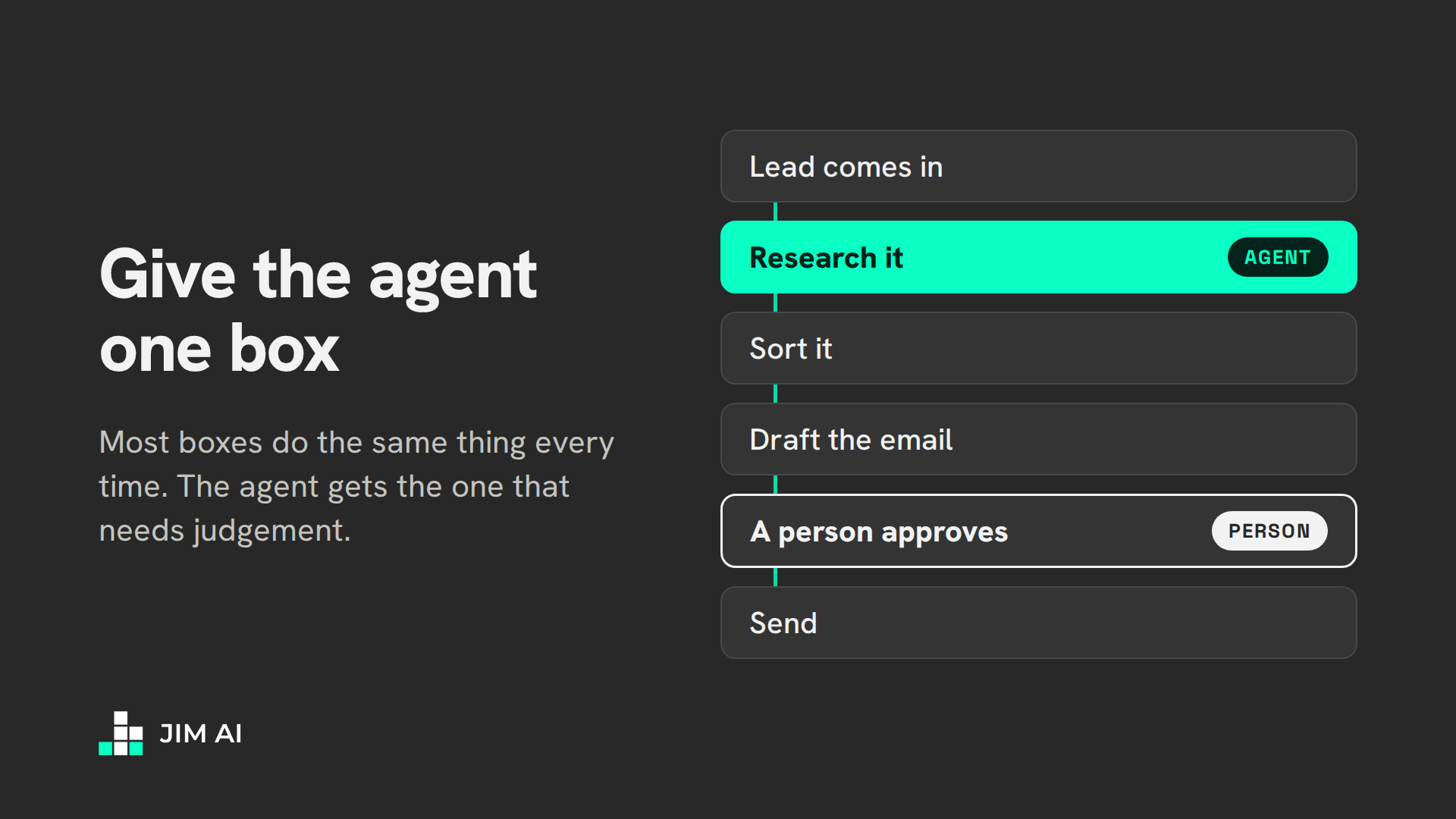
Once the job is drawn, most of the boxes are fixed. They do the same thing, in the same order, every time. One box, sometimes two, needs judgement, and that’s the box the agent gets.
Vercel, the web company, published a good example last November. Their process for new sales leads has five steps. The AI researches the lead, sorts it and writes a follow-up, then a person approves it in Slack before it goes out. Only the research step is an agent. Vercel says one person now does the work of ten, and the other nine have moved onto more complex sales work.
Vercel still calls the whole thing an agent. So does almost everyone, me included. Gartner reckons only about 130 of the thousands of companies selling agents are selling the real thing.
So when someone tries to sell you an agent, ask what it decides by itself. If it just follows the steps, you’re buying a workflow with a fancy name, which is often exactly what you needed anyway.
3. Put A Fence Round It
The fence is the list of things the agent can’t do on its own. It can choose how to word an email. Anything that sends, spends, publishes or makes a promise sits outside the fence, behind a rule or a person.
You’d do the same with your new starter. They can draft the email to the client, but they check with someone before they change the price or offer a discount.

SaaStr, the software conference company, found this out the expensive way, and to their credit they wrote about it publicly. Last December, founder Jason Lemkin explained how one of their sales agents set up its own test, offering free tickets to their big annual conference. Nobody had asked it to or approved it, and SaaStr paid over $2,000 out of their own pocket. Another of their agents was still promoting a London event after it had happened, which a simple date check would have caught.
I’ve seen my own versions of this, changed enough that nobody will recognise them. One agent kept emailing a client who’d already said no, which a person would never do. Another started giving away free membership. A third sent a whole email sequence in one go. And one pulled information from the wrong accounts and from sources nobody had checked.
Each of those needed one simple rule, written down before the agent started: stop when someone says no, never touch the offer, stick to the timing, and only use the approved lists. The tools help you do more, but the final check stays with your team.
4. Let It Earn A Bigger Box
The box can grow, but only once the agent has earned it. It’s like learning to drive. First you drive with an instructor who can hit the brake. Only after the test do you get the car to yourself, and even then there are speed limits.
Gartner describes four levels for agents that work the same way. It also predicts that by 2027, 40% of large companies will demote or switch off agents that run on their own. The reason is gaps in the rules and checks around them. Those agents got the keys before they’d earned them.
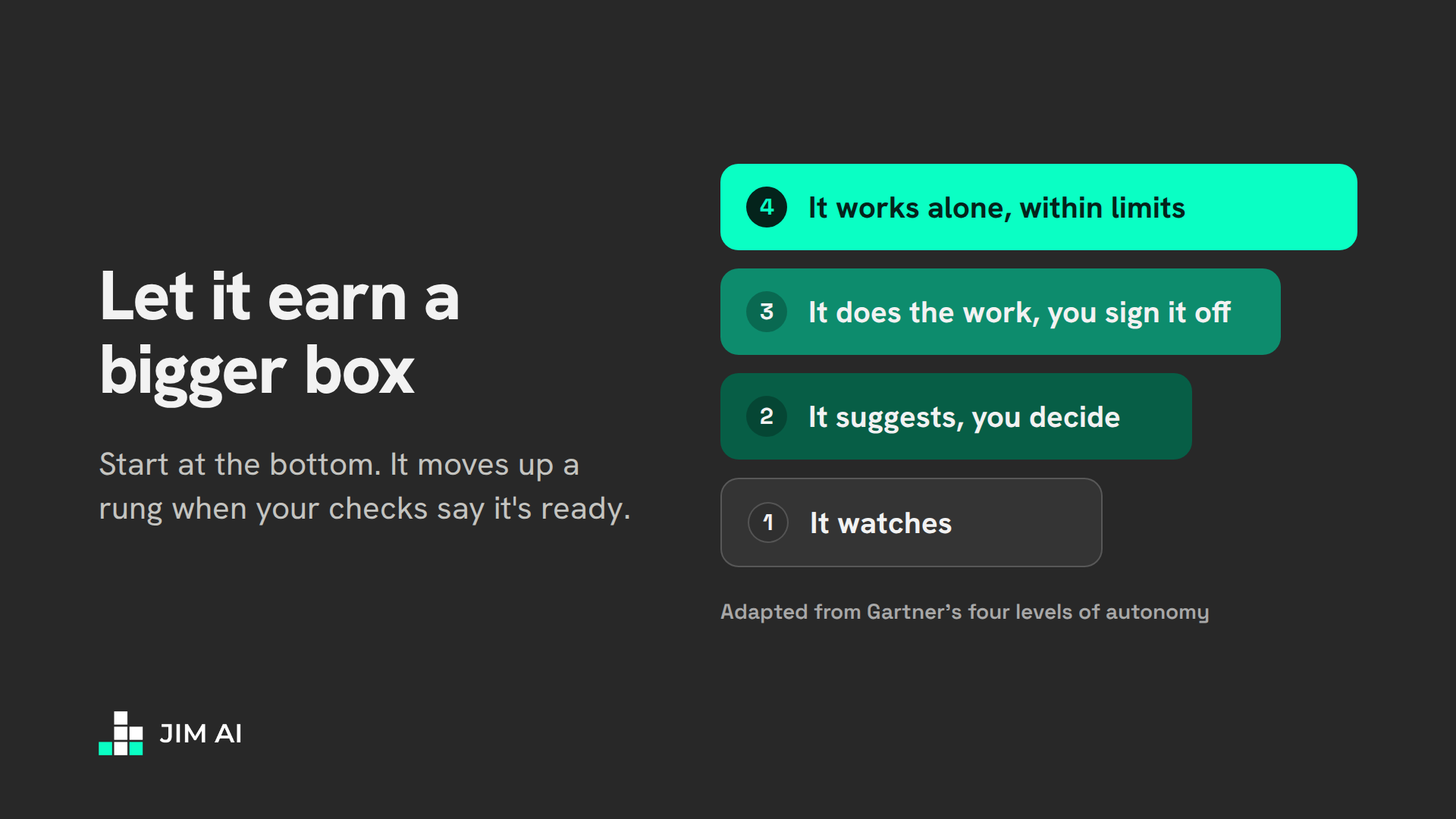
We always run a small pilot first, and the only test that counts is real work with the real team. The wording will change a bit every time, but the facts underneath shouldn’t. You keep checking samples until you’re confident it can tell what’s right from what needs a person, and then it moves up a level.
The best example I’ve seen is Major Tom, a marketing agency that used HubSpot’s prospecting agent on old contacts who’d gone quiet. Their co-founder tested it on 200 of his own contacts first. Then they used it on 1,000 contacts who’d been good prospects before, rather than all 7,000 or so. Nothing went out until someone on the team approved it, and anyone who replied with a no was taken off the list and passed to a person. By their own account, it booked 24 meetings and led to over $750,000 in proposals.
The Agents We Actually Keep
I’ve built agents that didn’t earn their place. One was a lead scoring agent in HubSpot. It worked perfectly well, and it still cost more to look after than the leads it touched were worth.
These days we keep very few agents in our own business, and they’re lean. The ones that have stayed have two things in common. They barely need looking after, apart from a model update every few months, and we actually use what they produce. Everything else we run is a workflow, and so is everything we’ve built for one of our agency clients, whose team went from 60% using AI to 100%.
In my experience, anything heavier makes more sense in much bigger companies. Big agents need a lot of looking after and take a long time to build properly, and most of that time goes on the systems behind them, especially the data. If something in your database is wrong, the agent has no way of knowing, and it’ll act on it anyway. Someone on your team might at least ask.
Then there’s the running cost, the risk, the time spent checking, and how hard it is to test against answers you know are right. Agents can be brilliant in the right box, but they’re expensive, so they should earn their place.
The Bit That Takes The Time
That’s how I’d build an agent. Draw the job, give the agent one box, put a fence round it, and let it earn a bigger one. Written down like that it sounds simple, and that’s what catches people out. The four steps are the easy part. The time goes on getting the job out of people’s heads, writing the rules, testing it on real work and keeping it right as the models change. That’s also what decides whether anyone actually uses it.

If you’d rather someone did that part with you, that’s what we do.