You're Not Behind, You're Being Asked To Change Jobs
I hear some version of "I feel really behind" in nearly every conversation I have about AI at the moment, mostly from people who are very good at their jobs.
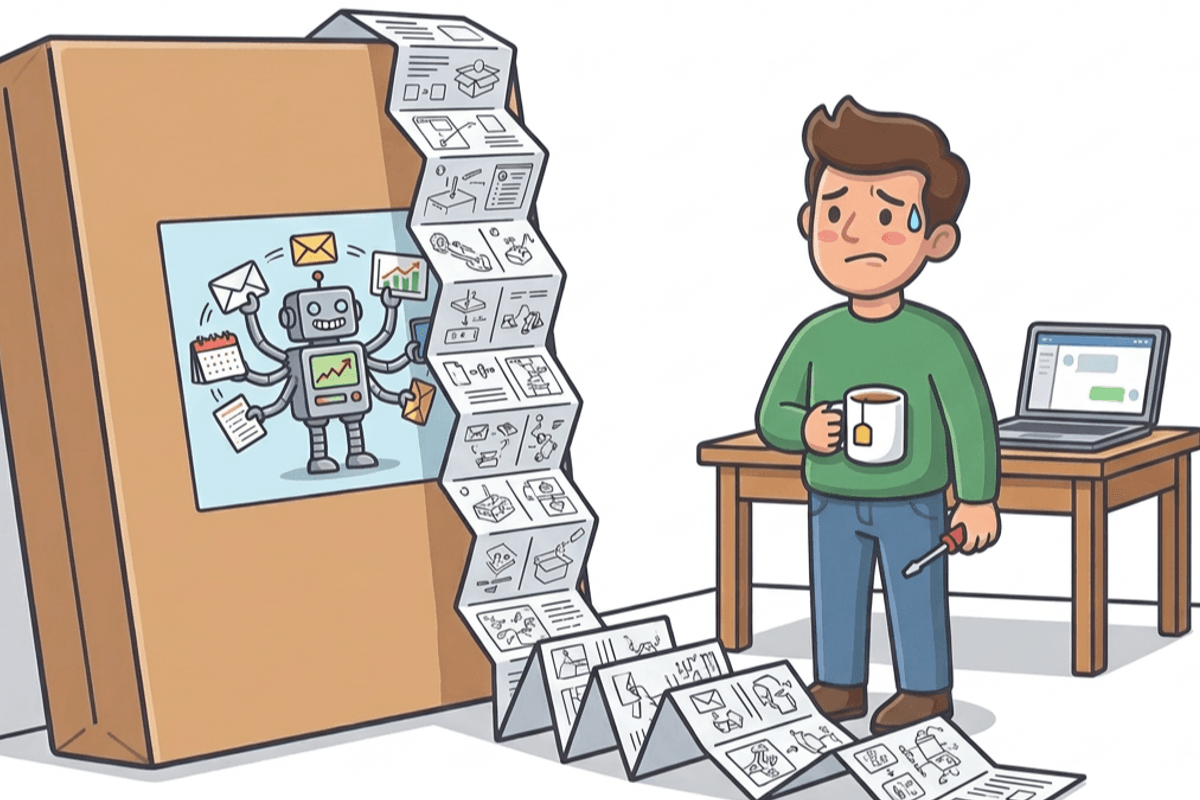
I hear some version of “I feel really behind” in nearly every conversation I have about AI at the moment, mostly from people who are very good at their jobs. Then I ask what they’ve been asked to do, and it tends to go like this. The business wants a content agent that does what a content person does, the tool they’ve been given to build it is Copilot, and they’re expected to fit it around the job they already had.
Somewhere above them, someone has often had a brilliant afternoon with Claude, and the expectation has travelled down from there. Microsoft said last year that every employee would become an “agent boss”, someone who builds agents, hands work to them and manages them. That’s a new job description, handed to people who already had one. When BCG surveyed nearly 9,000 people this year, 72% said the skills expected of them had shifted, and only 36% felt they’d had enough training.
And if anyone pushes back, the reply is nearly always the same question: can’t you just do this in Claude? You can do a lot of it, and I’ll come back to exactly how much at the end. Before that, I want to look at what spreadsheets can tell us about all this, what the tools you’ve been given are good at, what an agent really is, and how to tell when you’ve been handed a build.
Spreadsheet Skills Turned Out To Mean SUM
The closest comparison I’ve got is Excel, where most of the value has always come from the simple things rather than the clever ones.
When researchers went through more than 15,000 spreadsheets from Enron’s email archive (the company is better known for other things), SUM turned up in 72% of the ones that used functions, and 94.7% of those used fewer than ten different functions. That was a trading firm full of analysts.
Most people learned to add up a column and use a handful of formulas well, and that covered nearly everything they needed. A few became the person everyone asks about pivot tables. The macros were written by people whose actual job that was, and I’ve never met a business that sent its whole marketing team on a VBA course.
Decades in, we know where the value in a spreadsheet comes from and how far most people need to go to get it. We haven’t really got that guidance for AI yet, and it doesn’t help that it’s sold as something that can do everything.
And Excel was only ever one application. AI is a whole technology, turning up inside most of the tools you already use, so the gap between the everyday end and the building end is far wider than it ever was with spreadsheets. The pattern still holds, though. Everyone can get good at prompting fairly quickly, most people can go a long way further with proper training, and a few will happily chain tools together by hand. Building the thing that runs without you is the VBA end, and that’s a different job.
That’s also the job behind most of the amazing AI results you see shared, and the people sharing them aren’t wrong. They built for that, which is what’s earned them the right to talk about it. What you can’t do is hand your marketing team a chat window and be disappointed when they don’t immediately come back with a multi-agent system.
What You’ve Actually Been Given
When the business asks for a content agent, I think it’s picturing a content person: someone who knows the brand, the accounts, the calendar, what went out last week and what’s due on Friday. That’s a role, and a role is dozens of jobs.
It doesn’t help that the word agent gets used for three quite different things.
-
A configured assistant. Some instructions, a handful of files and a chat box. Most Copilot agents, Gemini Gems, custom GPTs and Claude Projects sit here. It waits to be asked, answers from what it’s been given and does nothing on its own.
-
A workflow with an agent in it. The steps are written down in advance, and one of them is handed to an agent that can only reach what that step needs. A person checks before anything goes out.
-
An agent in the full sense. It decides its own next step, works in your other systems and keeps going while nobody’s watching.
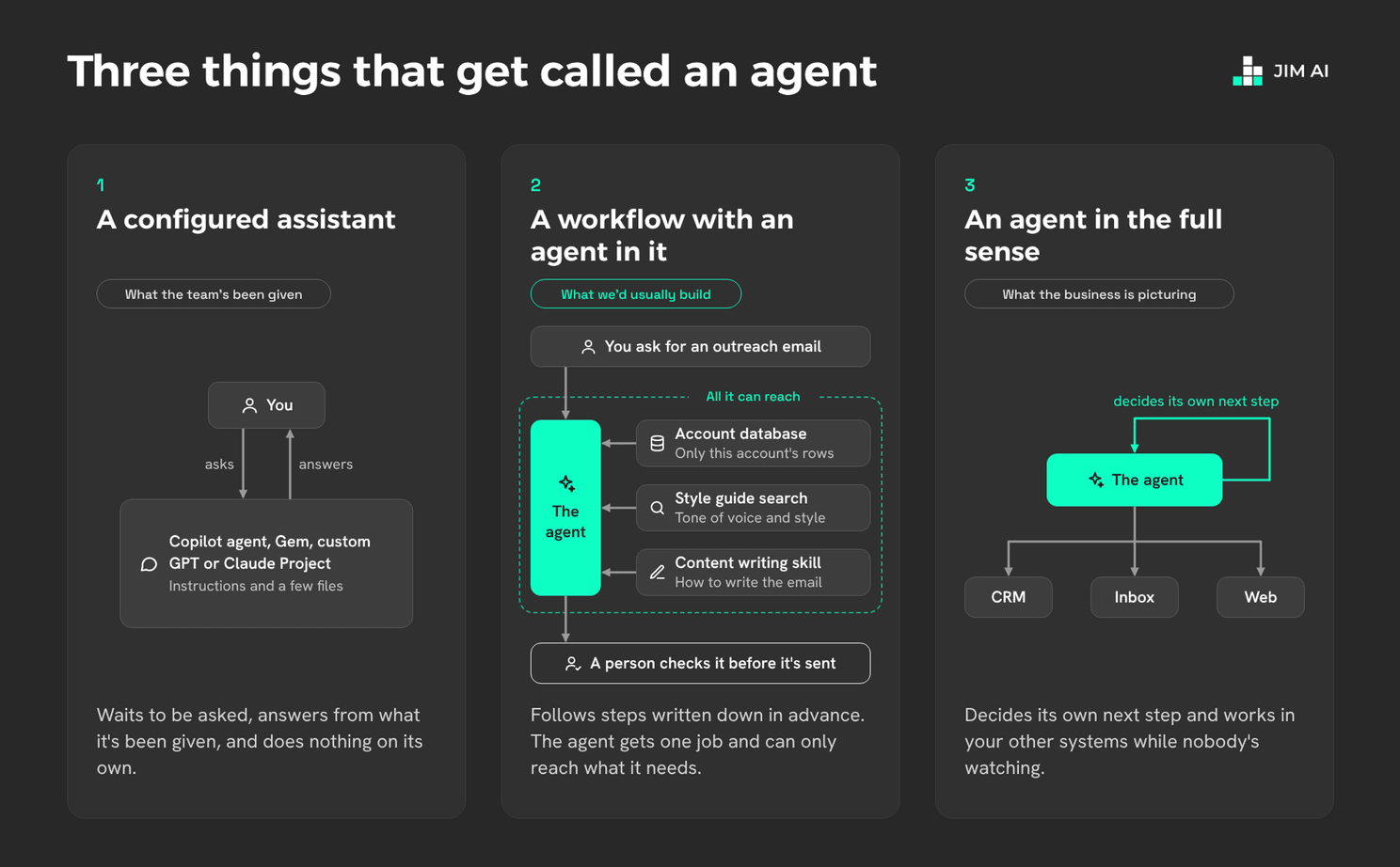
I wrote about telling the last two apart in How To Build An Agent. The business is picturing the third, and what the team has been given is the first. That isn’t me being unfair to Copilot. Microsoft’s own guidance describes the agents you can build yourself in it as lightweight question-and-answer helpers for you or a small team, built on content you already have. Anything that has to act in another system, like raising a ticket or routing a request, moves over to Copilot Studio, with more connectors and governance controls, and that’s usually a job for IT rather than marketing.
The first kind is brilliant at plenty: drafting in your voice from a proper brief, answering questions from your playbook, getting a first pass at research before a call, turning a messy transcript into something you can use. Set up well, it’ll make you noticeably better at your own job. What it can’t be is a person.
It Can Read, But It Can’t Look Things Up
Here’s one I’ve seen, with a few details changed. A team put everything they knew about every account into one big spreadsheet, attached it to a Gemini Gem and used the Gem to write their outreach. Google lets you add spreadsheets to a Gem as reference material, so they were using the product exactly as it was sold.
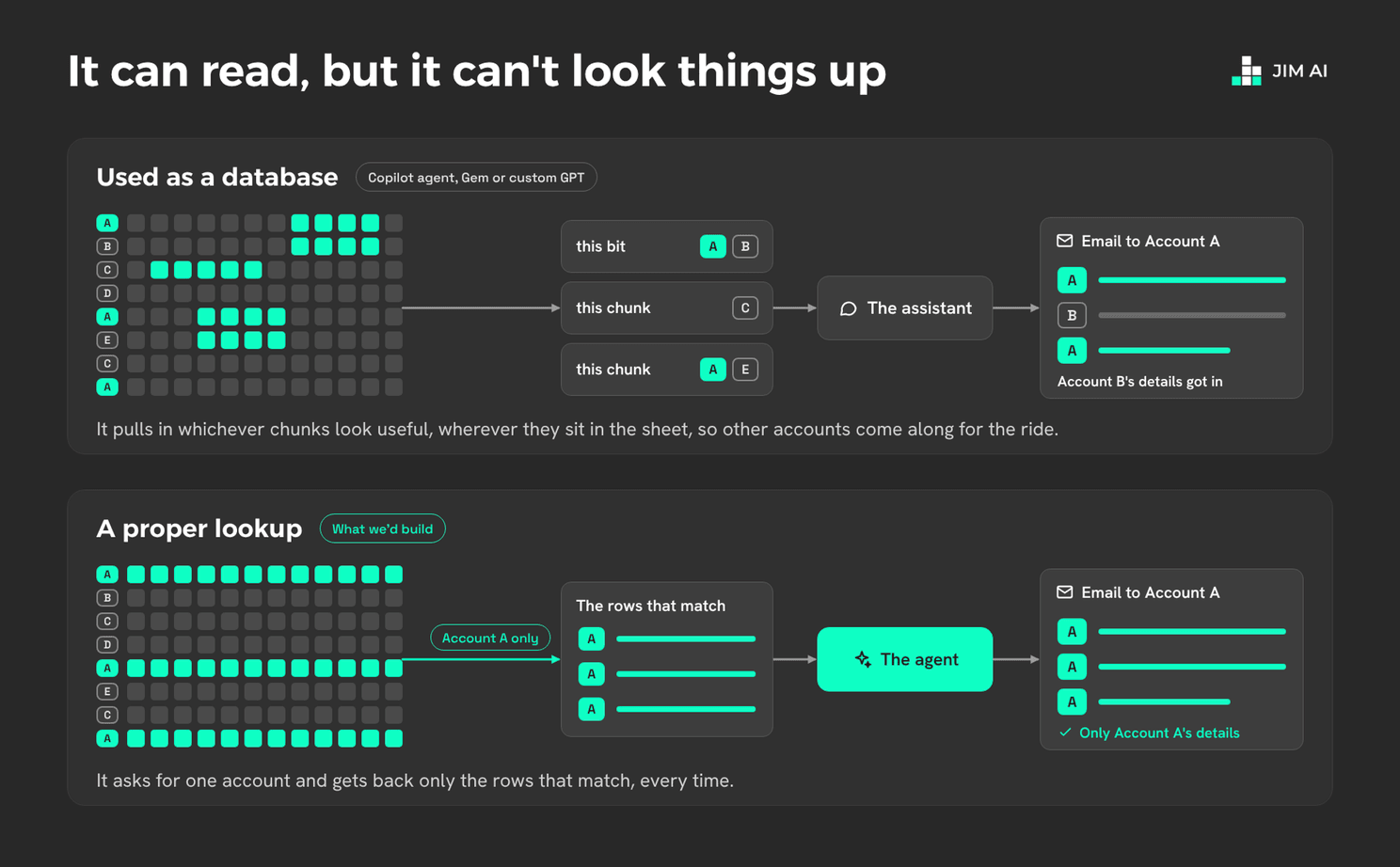
The trouble was the size of it. With every account in one sheet, the Gem stopped sticking to the account it was writing to and pulled in whatever looked most useful, whichever account it came from. The emails still read beautifully, so nothing about them looked wrong. Send one of those and a prospect is reading details about another company, which is a lot closer to a data incident than a bad email.
They’d used it like a database, and it isn’t one. A database looks things up, so if you ask it for one account you get that account’s rows and nothing else, every time. A Gem works from the sheet as a whole and does its best with everything in it, and there’s no step anywhere that says only use the rows for this account. The bigger the sheet, the worse that gets. Chroma, a company that builds databases for AI, tested 18 models and found they all got less reliable the more they were given to read, and worse again when the bit they needed didn’t closely match the question.
They’d written a very good prompt, too, which is the frustrating part. Even the best prompt in the world can’t add a step the tool doesn’t have, and the Gem was never going to put its hand up and say it thought this was risky, or that there was a better way to set it up. It’s been trained to be helpful and do what you ask, so it did.
The fix is the bottom half of the picture above, and it’s boring, which is usually a good sign. You ask for an email to one account, and the agent looks that account up in a proper database, so it only ever sees that account’s rows. It pulls your tone of voice and style from a separate search (a standard one does the job, nothing fancy) and writes the email with a content writing skill. Then a person checks it before it’s sent.
You could get halfway there in Excel, with a separate file for each account, but then someone has to remember to hand over the right one every time. In the build, the account, the sources and the check are all settled before the model writes a word, which is the rule I keep coming back to with agents: anything you can write down in advance shouldn’t be left to the model.
How To Tell When It’s A Build
So when you’re handed something like a content agent, there are three questions worth asking before you open Copilot. Does it need to run without you there? Does it need to reach into another system, like the CRM? And does anyone else need to rely on what comes out? If the answer to any of them is yes, you’ve been asked for a build.
Someone then has to work out which steps are fixed and which need judgement, get the data into a state anyone would trust, and look after the thing once it’s running. That’s a real job, and it only becomes yours if somebody decides it should.
A year after its agent boss prediction, Microsoft’s own research found that the organisation around people counted for more than twice as much of the AI impact they reported as their own mindset and habits did. By the organisation, it means things like culture and support from managers. So who builds it is a decision for the business, and in my experience most haven’t made it out loud yet.
So, Can You Just Do It In Claude?
A lot of it, yes, and you should. The assistant you’ve been given will make you better at the work you do yourself, and that’s worth getting properly good at.
Look at what went missing in that Gem, though. Which account this is for, what matters to them right now, what would be odd to mention: an experienced marketer makes those calls without noticing they’re making them. That’s judgement, and it’s the part of the job you were hired for.
When it is a build, somebody has to do it, and if you’d rather that wasn’t you, that’s what we do. We build it with your team, test it on real work and hand it over, and it becomes part of what we call your AI estate: the setup that tells AI how your business actually works, so it isn’t left guessing from one enormous spreadsheet.
If you’d like to know which of the things you’ve been asked for are builds, send them over. It’s a quick answer, most of the time.
Sources
- Microsoft, 2025 Work Trend Index: https://www.microsoft.com/en-us/worklab/work-trend-index/2025-the-year-the-frontier-firm-is-born
- BCG, AI at Work 2026: https://web-assets.bcg.com/eb/92/4b39b729403fb6fcae4ff974b234/ai-at-work-slideshow-jun-2026-1.pdf
- Hermans and Murphy-Hill, Enron’s Spreadsheets and Related Emails: https://repository.tudelft.nl/file/File_6407791c-a000-4062-acaf-63e04502dfdc
- Microsoft Learn, Agent Builder and Copilot Studio: https://learn.microsoft.com/en-us/microsoft-365/copilot/extensibility/copilot-studio-experience
- Google Workspace Updates, files in Gems: https://workspaceupdates.googleblog.com/2024/11/upload-google-docs-and-other-file-types-to-gems.html
- Chroma, Context Rot: https://www.trychroma.com/research/context-rot
- Microsoft, 2026 Work Trend Index: https://www.microsoft.com/en-us/worklab/work-trend-index/agents-human-agency-and-the-opportunity-for-every-organization