The Twenty-Minute Agent
Why so many AI projects fail, and how to spot the work that makes one last.

You’ll have seen the number by now. Somewhere around ninety-five percent of corporate AI projects deliver no measurable return.
We’ll get to why, bear with me. First I want to talk about why so many of us keep reaching for this stuff anyway, because the pull is completely understandable.
The Friday admin job you’d hand over in a heartbeat
We’ve all got the task we can’t stand. The weekly admin job with no skill in it and no joy in it, the one you put off till Friday afternoon and then grind through with an episode of Friends on in the background so it stings a bit less. Two hours of your life, every week, for as far ahead as you can see.
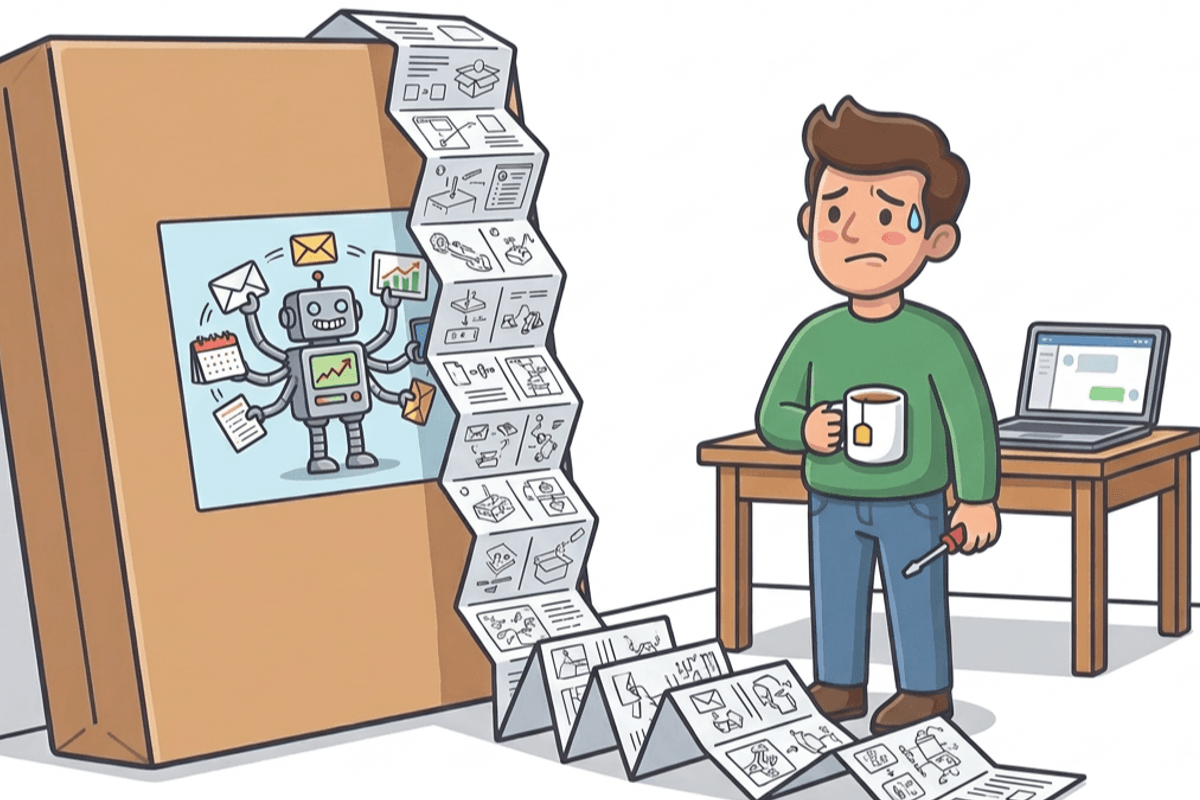
So when someone tells you an agent could just do that for you, and you’ve seen the clips where somebody builds one in twenty minutes flat, the sum isn’t a hard one. Twenty minutes of setup to never face the Friday job again. Where do I sign.
I’m not here to tell you that’s a daft thought. There are huge chunks of all our working lives that should be automated, and wanting shot of them is the healthiest reason to look at any of this. Wanting rid of it isn’t where this goes wrong. Where it goes wrong is the gap between the clip and the thing that actually runs.
The demo really is that fast
The reason this is so hard to see clearly is that the twenty-minute agent isn’t a lie.
You can stand up something that looks like witchcraft in twenty minutes. I’ve done it. I’ll do it on a call with you if you fancy it. The models are that good now, and a slick demo is cheap to put together.
The catch is that a demo is to a working system what a LEGO car is to a real one. All the right parts, roughly the right places, unmistakably a car, and the last thing you’d do is take it on the motorway.

It also depends a lot on what you point it at. If you’re a YouTube influencer with a tidy spreadsheet of two or three hundred rows, then of course the twenty-minute agent works, and it works beautifully. Point that same setup at twenty thousand lines of the last fifteen years of your HubSpot CRM, with the duplicates and the half-filled fields and the three different ways everyone’s spelled the same company, and you’re looking at an entirely different beast.
The demo is true as far as it goes, it just doesn’t go very far. It hasn’t met the data that’s messier than the tidy example. It hasn’t met the week when the person who understood it has moved on. It hasn’t had to run to the standard your business actually holds, without you stood over it. A demo shows you a perfect moment. What you’re buying is whether it still works in month six, and whether anyone’s still using it.
A demo shows you a perfect moment. What you’re buying is whether it still works in month six, and whether anyone’s still using it.
What month six actually looks like
A while back I rebuilt a report for a client that used to take about thirty hours. We got it to roughly six, at better quality than the manual version, and the pieces were modular enough that every build after that leaned on the last one. That groundwork is why we can now turn out a report in under ten minutes that used to take two to four months.
That first build took the best part of four weeks before it saved anyone a minute, because we had to rebuild the process before we could automate it. We sat with the team and worked out what they actually did, including the judgement they brought that nobody had ever written down, and turned it into logic a system could follow. A lot of that was extraction. Pulling the reasoning out of people’s heads, getting the agent to match their thinking step for step, and updating the internal documents and context files so it had something solid to stand on. Four weeks of unglamorous graft, and then it started paying back, and it’s paid back ever since.
Now picture the same job done without any of that. The process never gets mapped, so the agent automates whatever mess was already there. The edge cases never get tested, so the first odd input produces confident nonsense and nobody catches it. There’s no handover, so the one person who understood it becomes a single point of failure. And somewhere around month four or five, the team stops trusting it and drifts back to doing the job by hand, Friends on in the background. The licence keeps renewing. The work keeps happening manually. You’ve paid for something that now lives in a drawer, and the Friday job is still yours.
So, about that ninety-five percent
Remember the number from the top. This is where it comes from.
It’s MIT’s, from a 2025 report by their Project NANDA team called “The GenAI Divide”. Ninety-five percent of organisations saw no measurable impact on profit and loss. Their explanation for why is actually really interesting. It wasn’t the models at all. It was how the tools were brought in. Generic tools work brilliantly for one person, because they’re flexible, and then stall inside a company because they don’t adapt to how that company actually works.
That matches what I’ve seen. When most of these were rolled out, the assumption was that as long as you had the tool, you’d made the right move. Buy it, put it in front of the team, done. Some businesses went further and decided the only way to keep their data secure and hold on to a competitive edge was to build a model of their own. I understand both instincts, and neither one gets near the actual problem, which is that almost none of our processes were ever designed with AI in mind. So when you plonk an agent on top of one, you’re basically hiring a graduate on day one, handing them logins to a few broken systems nobody’s documented, and telling them to go and sort it out. They’re bright, they’re willing, and they’ve no idea what they’re doing, because the mess was there long before they arrived. The agents that actually work are the ones where you fix the operations and the workflow first, until the job the agent has to do is clean enough that it can actually succeed at it.
Three questions to ask anyone who says they can fix it
Once you know the problem is the work around the tool, you’ll notice there’s no shortage of people who’ll tell you they can sort that out for you, and most of them believe it. Some of them can. The hard part, from where you’re sitting, is telling the difference before you’ve paid anyone, because the pitches sound alike and the demos all look brilliant.
Next time anyone, me included, says they can fix it, ask them these three things.
Where’s the actual work? If the honest answer is “the tool does it”, be careful. The tool is the cheap part now. If they can’t point to the data preparation, the workflow redesign, the testing and the change work, they’re selling you the LEGO car.
What happens to this in month four, when an odd input hits it and you’ve moved on? You’re listening for whether they’ve thought past the demo. Maintenance, edge cases, who watches it, what it does when it doesn’t know the answer. A good reply here is unglamorous and specific. A bad one is a shrug.
And who owns it when you’ve gone? This is the one that protects your business. The right kind of build embeds how your team already works and leaves you holding something you own and can grow. The wrong kind leaves you renting your own process back from a consultant.
A pitch that survives all three is rare, and it’s the one worth your time. A pitch that fumbles them is the one that ends up in the drawer by month six.
The honest bit
Point those three questions at me, by all means. I’d rather you did.
In a market where ninety-five percent of this stuff delivers nothing, everything I’ve worked on across clients is still running. So far that’s a hundred percent still in use, and the smallest efficiency improvement across any of them has been fifty-five percent. A couple have grown into second and third phases because they kept earning their place. I’m quite proud of that, and I’m going to let myself be, because you don’t land in the five percent by luck. You land there by doing the boring four weeks before you reach for the clever twenty minutes.
If you’ve got one of these on the go, or you’re being sold one, and you want a second pair of eyes before you sign anything, you know where I am.